
First-time user conversion
Redesigning the trolley and checkout experience to reduce friction and increase conversion
Role:
Senior-Lead Designer
Timeline:
8 months
Company:
Ocado - ecommerce platform
Project context
Ocado OSP is an e-commerce platform for online supermarkets. Launched over 25 years ago as Europe’s first online grocery retailer, it has since scaled into a global platform used by 13 major supermarket chains across 11 countries.
Today, retailers like Bonpreu and Alcampo in Spain, and others in markets such as Japan, South Korea, Australia, and France, run on this platform. Designing for Ocado means creating experiences for a diverse, global audience, balancing scale, consistency, and local needs.
When we looked at first-time shoppers across markets, data and qualitative research revealed a consistent pattern: first-time shoppers were most likely to drop-off at the end of the journey.
As a Senior Product Designer, I owned the Trolley and Checkout experience, focusing on reducing late-stage friction, protecting user effort, and increasing confidence at the point of purchase for first-time users.
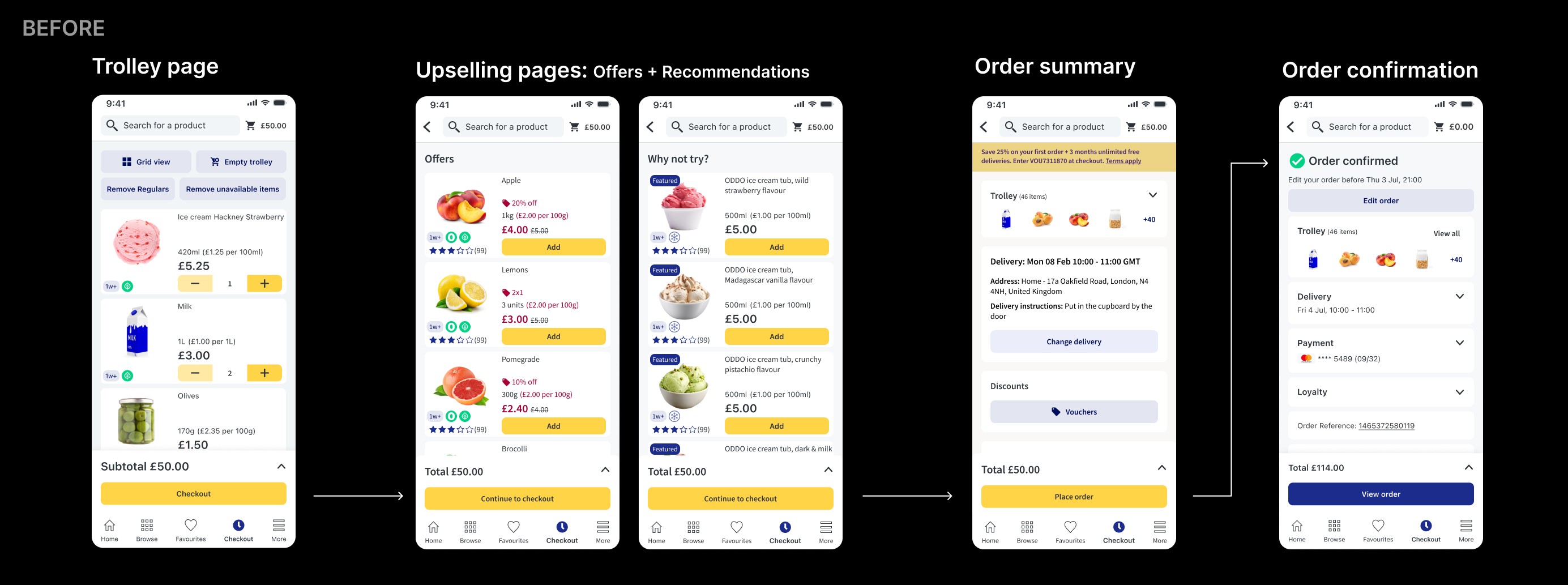
Existing flow - from Trolley to Order confirmation
Problem to solve
First-time shoppers were dropping off at the final stages of the journey. Several hypotheses could explain this behaviour and I began uncovering the underlying issues.
They often encountered out-of-stock items, forcing them to rebuild their basket after investing time; many reached checkout only to realise the minimum spend for delivery hadn’t been met, blocking completion; the trolley felt cluttered, making it harder to quickly review the order; vouchers and savings were hard to apply and easy to miss. And overall, the checkout flow included several upsell steps, adding unnecessary friction to the checkout experience.
From a user’s point of view, this felt like effort being taken away. And for someone shopping for the first time, that’s often enough to abandon entirely.
The core was a lack of confidence and friction at the final steps.
If the trolley and checkout feel unpredictable or unclear, first-time shoppers don’t feel safe completing the order.
Pain points
Cluterred Trolley page
Too much visual noise and competing elements made it harder to quickly review and confirm the order.
Minimum Spend not met
Shoppers reached the end without realising they hadn’t met the minimum spend, creating frustration and drop-off.
Too many upselling pages
Checkout included multiple upsell pages that disrupted the flow and felt overly pushy
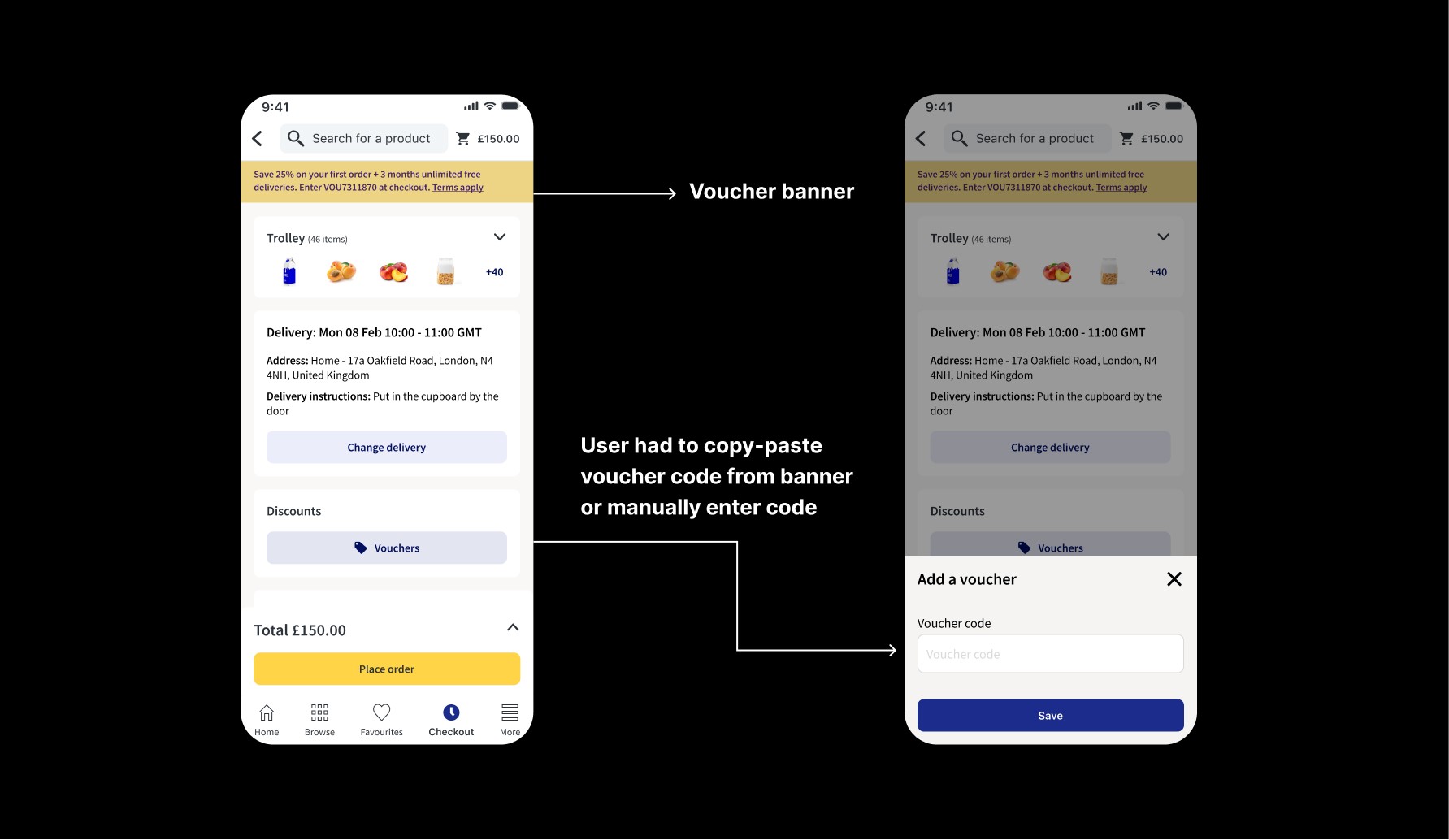
Voucher code hard to apply
Vouchers weren’t visible when needed, forcing manual entry and leading to errors.
Out-of-Stock items
Users discovered unavailable items at checkout, forcing them to rebuild their basket after investing time.
Unclear Order Summary page
Order confirmation was too cluttered, making it hard for users to focus on key information and next steps.
Data
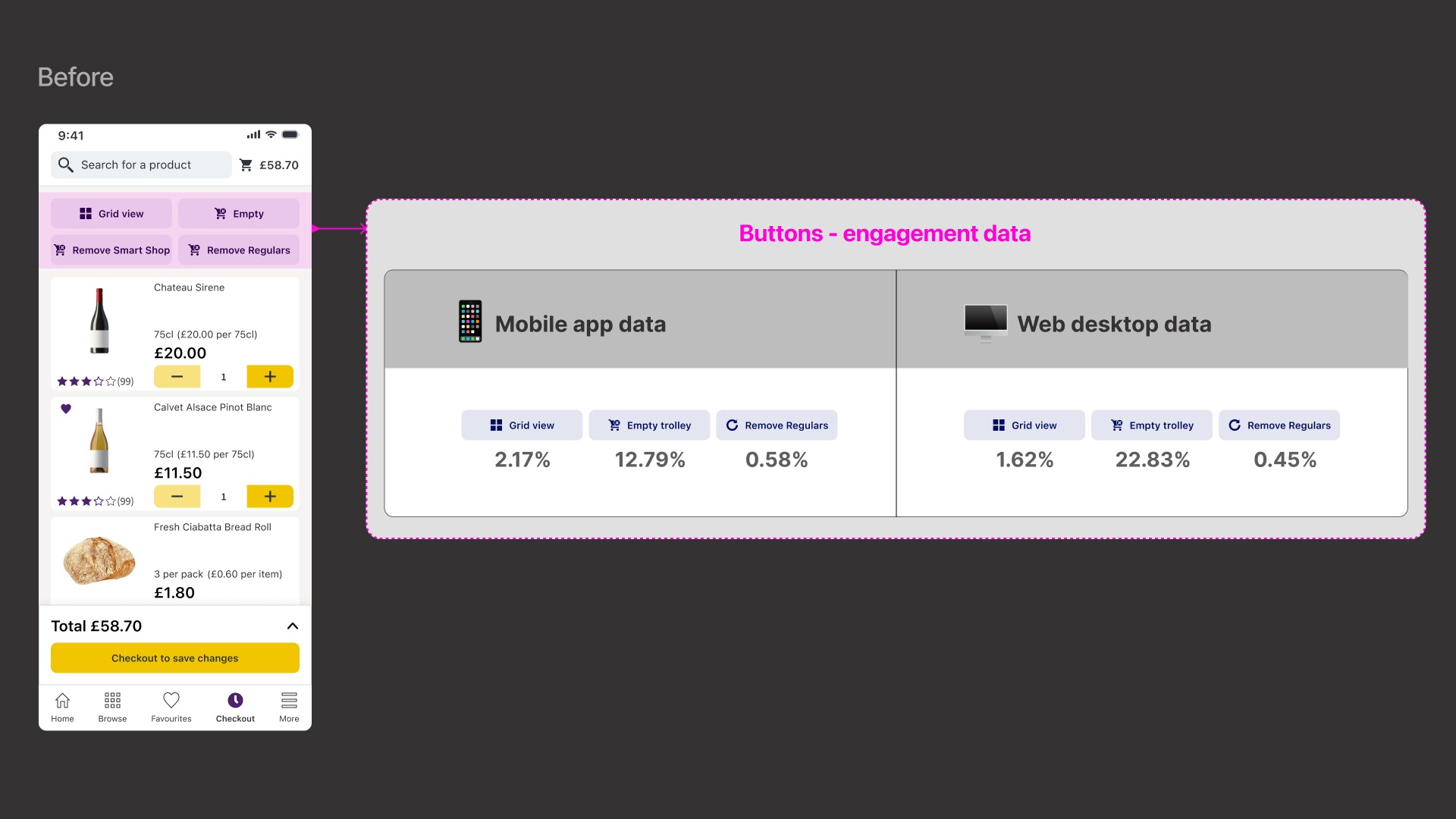
By reviewing how users interacted with the page, I identified several low-engagement actions that could be simplified or removed.
Design sprint
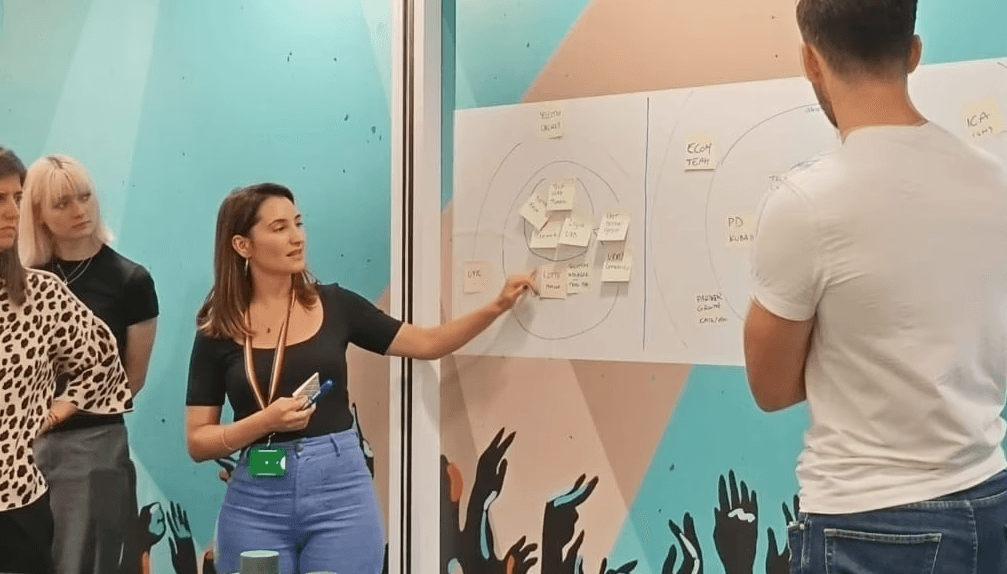
After gathering research and data, we ran a 2-day design sprint focused on improving first-time shopper conversion. We discussed opportunities to explore, along with feasibility and impact vs. effort, and I organised and facilitated an ideation session. I then used Figma to rapidly prototype a series of potential experiments.
We aligned on focusing first on the trolley page, as it’s a critical moment where users review their order and decide whether to continue or drop off.
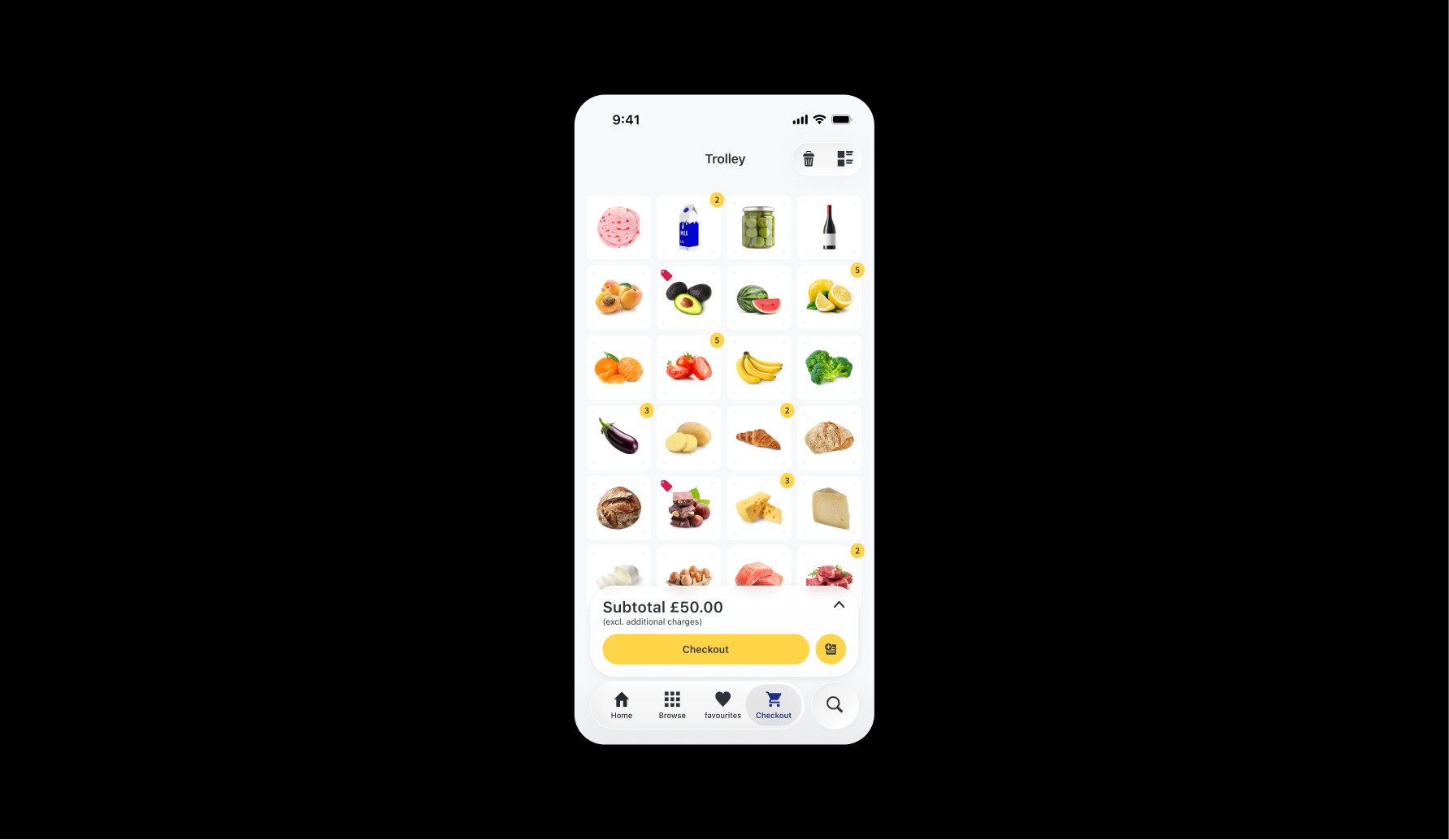
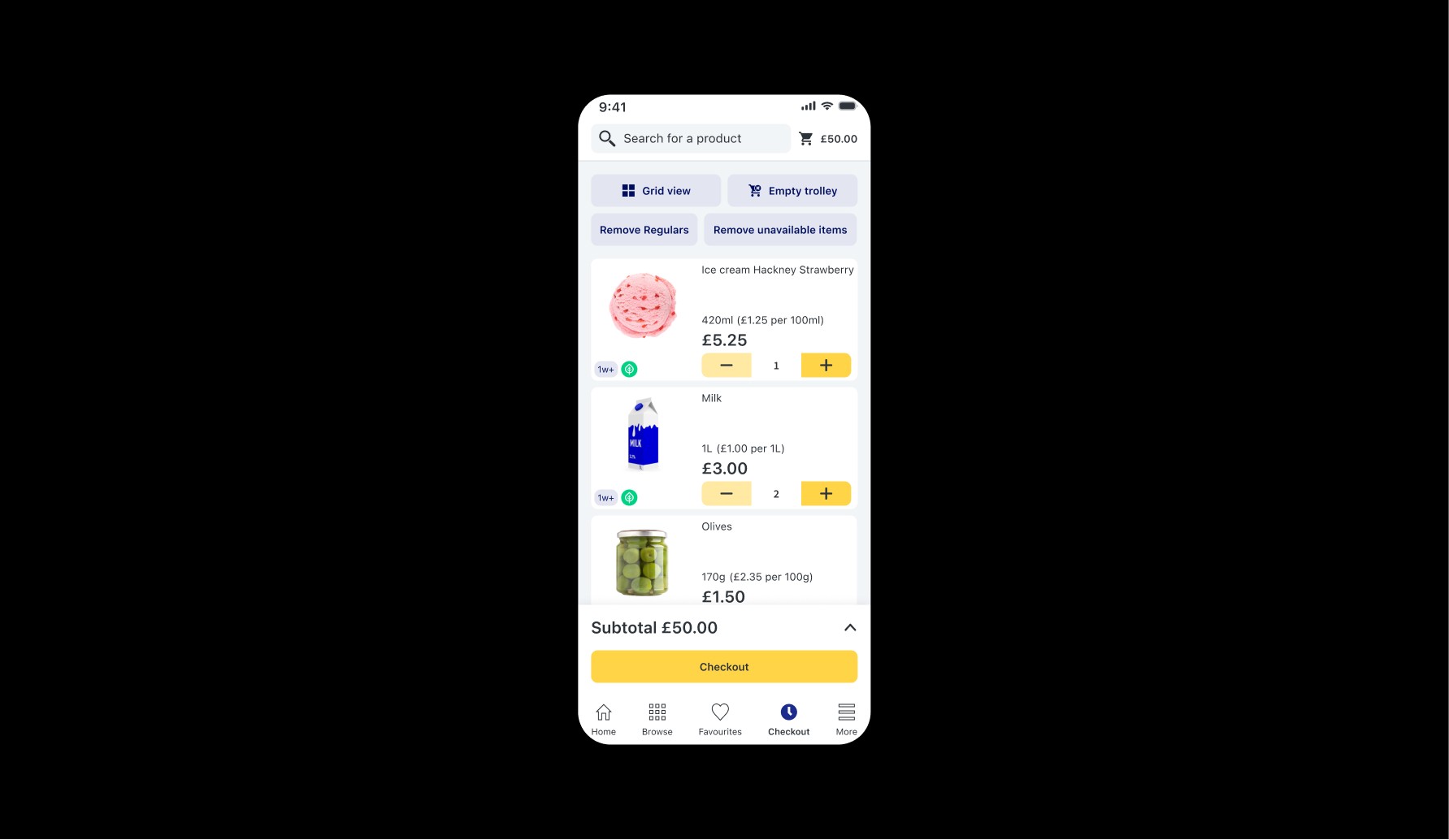
Simplified the interface by removing low-engagement actions (based on data) and replacing them with more recognisable, lightweight icons.
Set the foundation for a more native-first experience
Shifted the default view from detailed list to grid view, giving users a quick “bird’s eye view” of their shop.
Reduced visual noise so the page feels closer to what you’d expect from a physical trolley. A simple double-check:
“Do I have everything I need?”
Move the slider to see the BEFORE - AFTER page redesign

Making checkout easier to complete
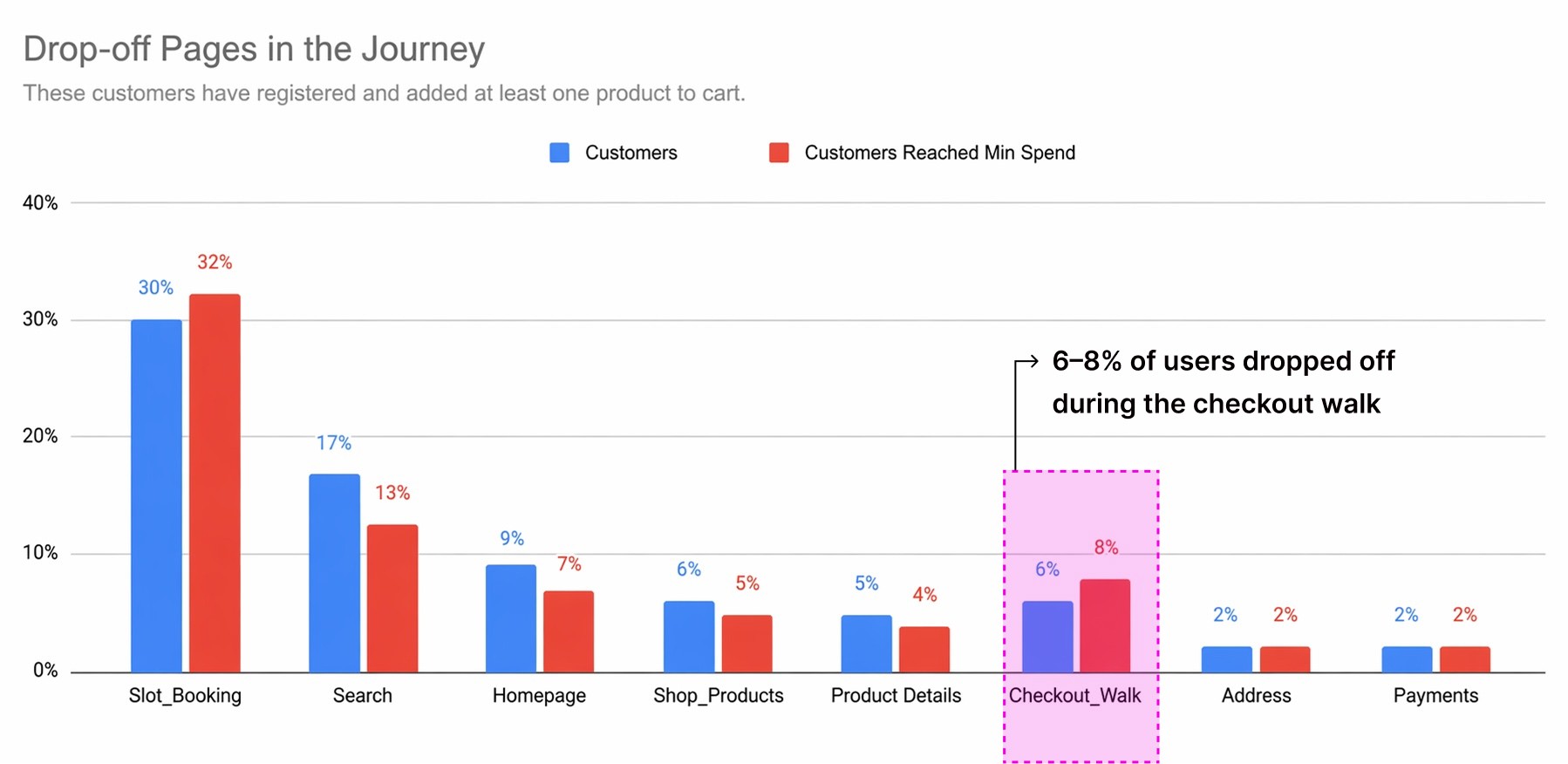
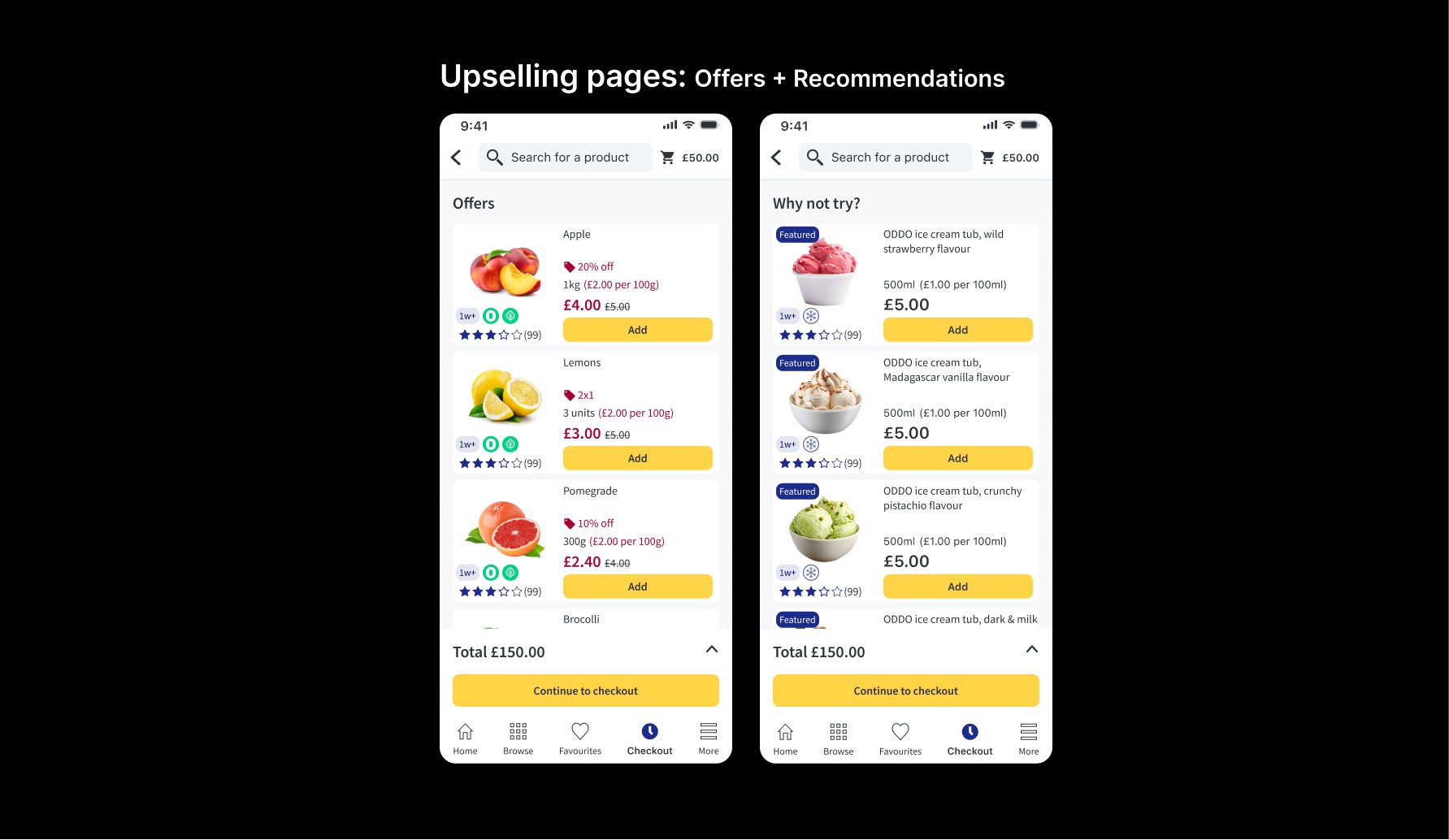
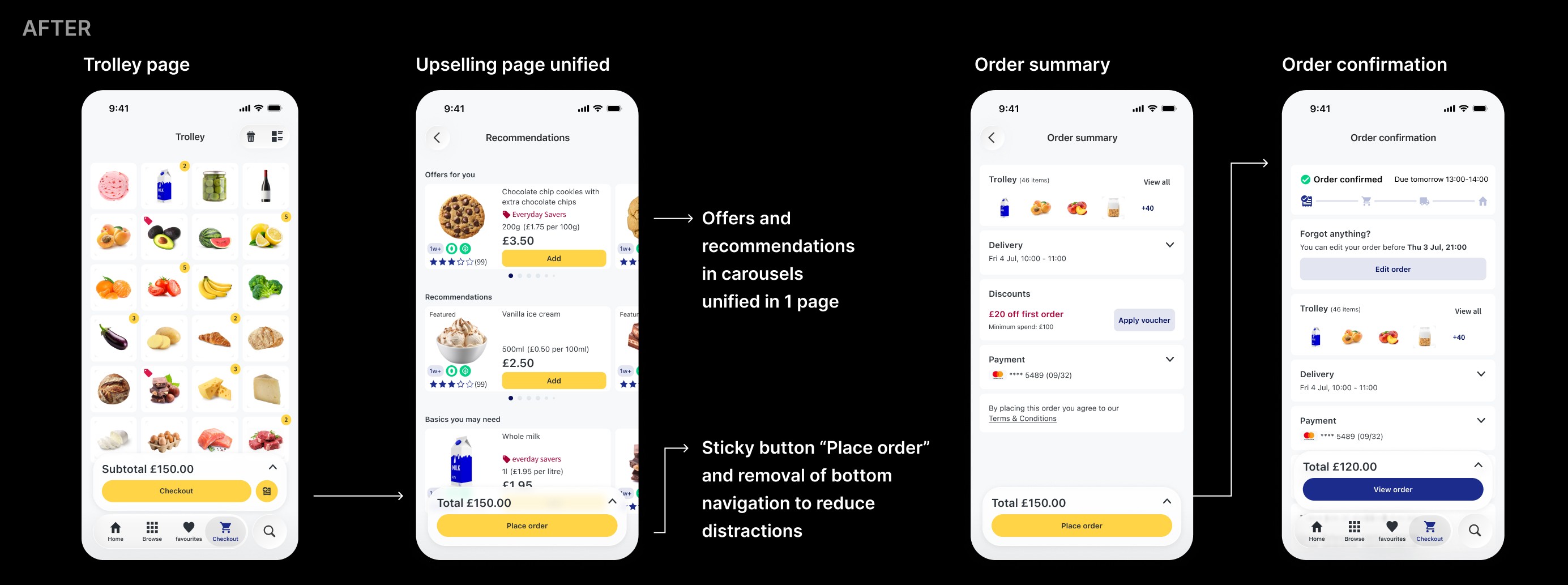
I redesigned the checkout walk to address a key drop-off point, where 6–8% of users were abandoning the journey. Previously, users had to go through multiple steps (up to 3 pages of offers, recommendations, featured products), which slowed down the flow.
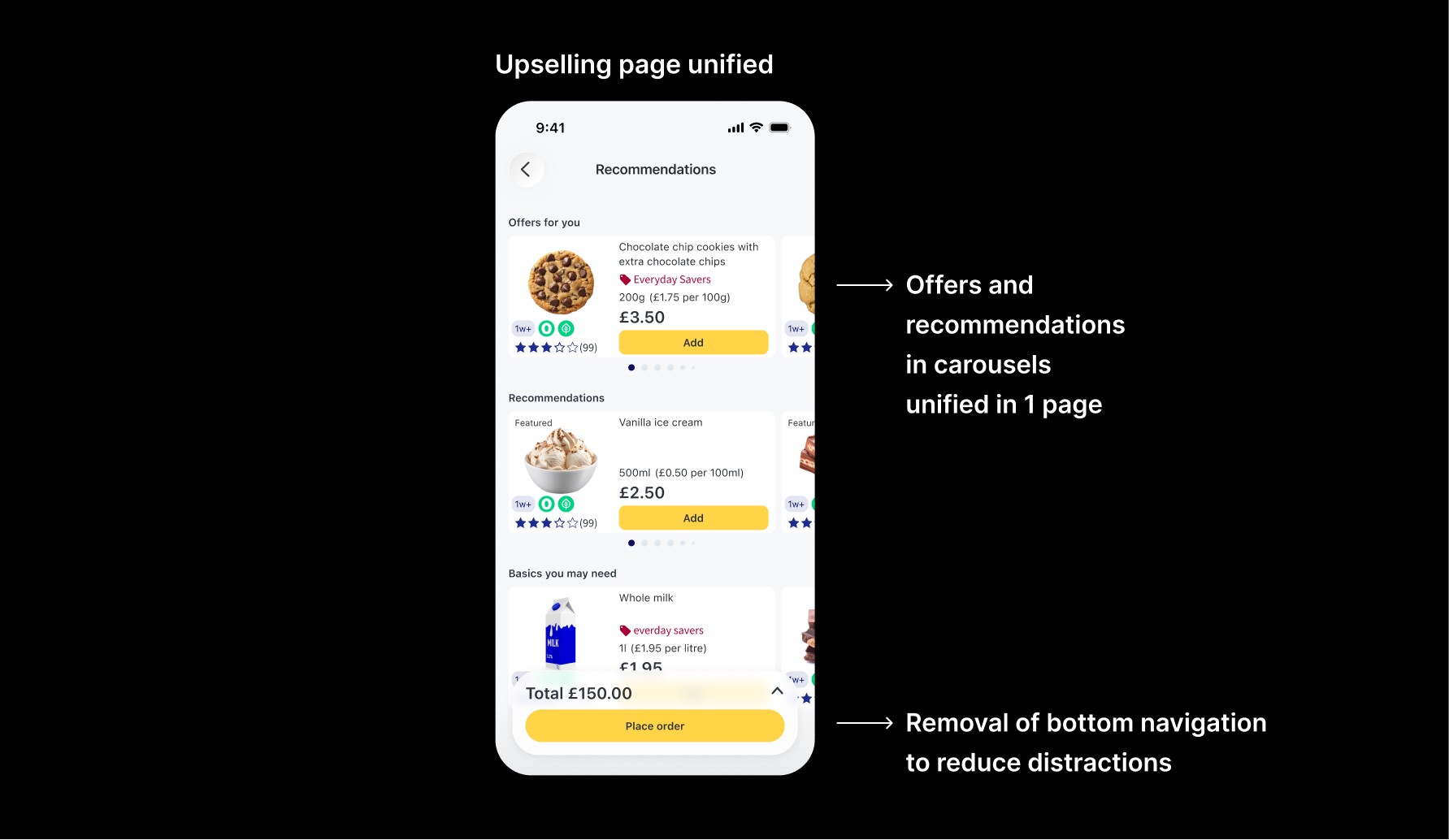
To simplify this, I consolidated these into a single page and used carousels to surface upsell content without interrupting the path to payment.
I also removed the bottom navigation to reduce distractions and keep users focused on completing their order.
This approach balanced user needs and business goals, preserving upsell opportunities while making them less disruptive and easier to navigate.
Move the slider to see the BEFORE - AFTER flow redesign
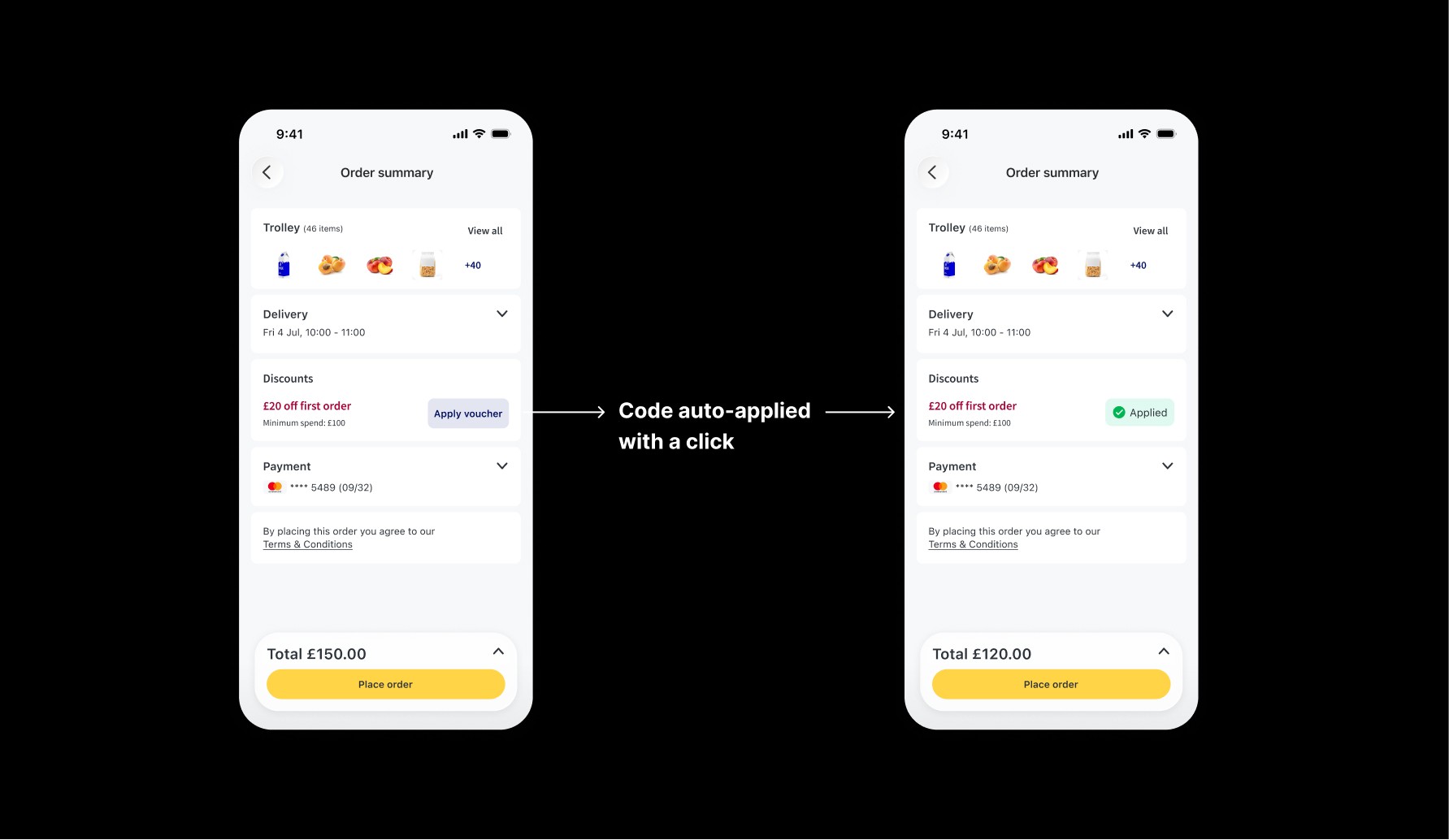
Making vouchers easier to apply
I redesigned the voucher experience to make available discounts clearly visible and easy to apply at the right moment. Previously, users had to enter vouchers manually, which led to missed opportunities and errors.
By surfacing vouchers directly in the flow, users could apply them with a single interaction, reducing friction and reinforcing the value of their order.
Move the slider to see the BEFORE - AFTER page redesign
The new improved flow
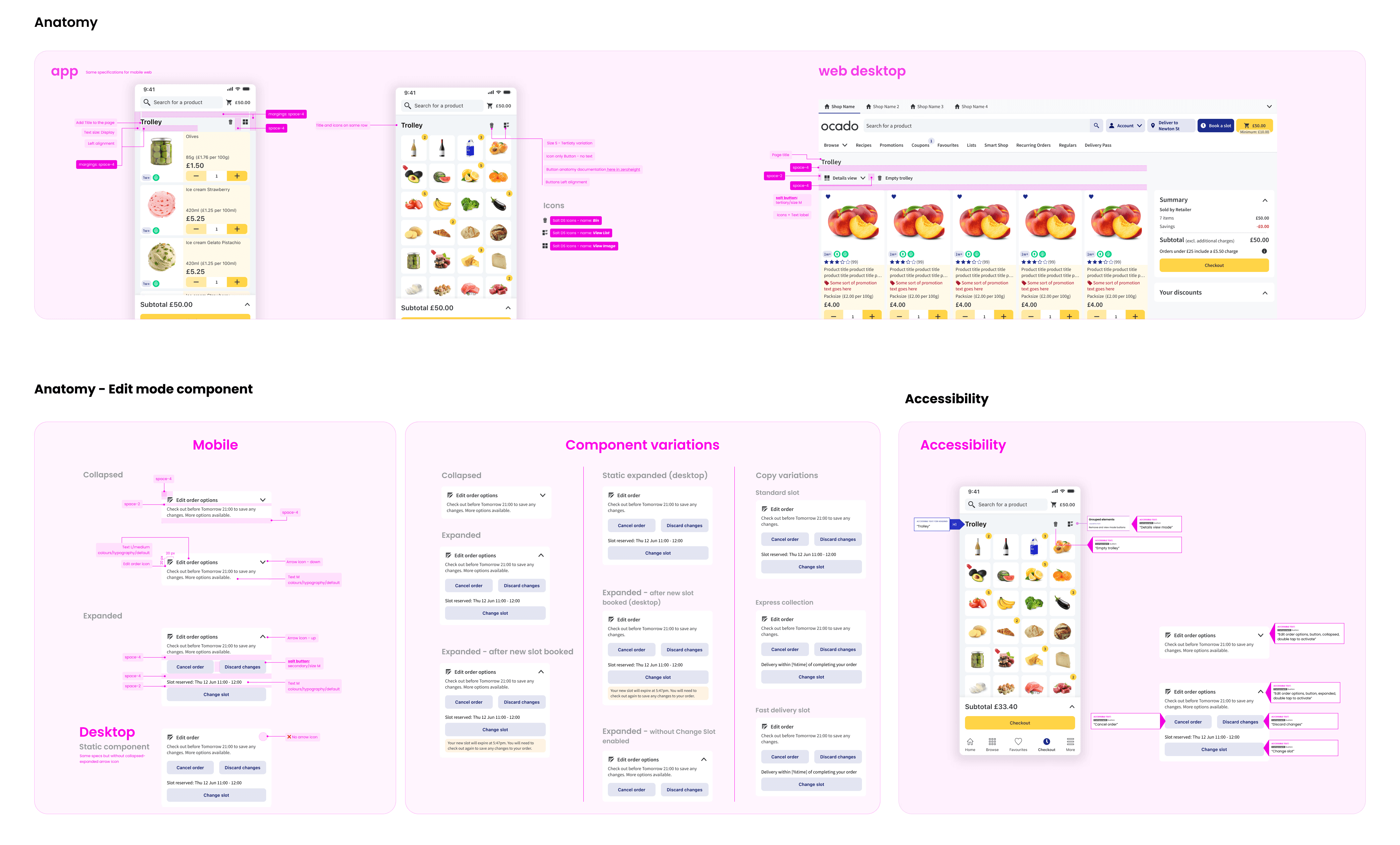
Documentation and accessibility
I prepared clear specs and documentation to support a smooth handoff to engineering, making sure everything was easy to understand and implement. I also kept accessibility in mind throughout the process to ensure the experience works well for everyone.
Testing
Multiple design variations were tested using Optimizely
Key metrics included:
Conversion (progression & completion)
Drop-off (step-level abandonment & time to complete)
Voucher usage (adoption & errors)
Business impact (AOV & upsell engagement)
Results and impact
Increase in checkout completion
rate and lower drop-off between checkout steps
Increase in voucher usage and fewer errors from manual entry
Overall, these changes helped reduce friction at critical moments in the journey, leading to improved progression through checkout, higher completion rates, and increased engagement with vouchers.
